

The Impact of Different Packaging Sizes on Jewelry Products

In the jewelry industry, where products range from delicate stud earrings to bulky statement necklaces, packaging size is far more than a logistical detail—it directly shapes product protection, consumer experience, brand perception, and operational efficiency. A mismatched packaging size (too large or too small) can undermine even the most exquisite jewelry, while a well-calibrated size enhances value at every touchpoint. For jewelry brands and packaging designers, understanding how different sizes impact products is critical to balancing functionality, aesthetics, and cost.
1. Product Protection: The Foundation of Packaging Size
The primary purpose of jewelry packaging is to shield delicate pieces from damage—whether during shipping, retail display, or consumer storage. Packaging size directly determines how well this protection is delivered, with both undersized and oversized options posing unique risks.
Undersized Packaging: Risk of Damage and Deformation
Packaging that is too small for the jewelry forces the product into a constrained space, leading to physical harm:
- Scratching and friction: For pieces with gemstones (e.g., diamond rings) or polished metals (e.g., 18k gold necklaces), undersized packaging compresses the jewelry against the box walls or inserts. This friction can scratch gemstone surfaces, dull metal finishes, or even loosen prongs holding stones in place.
- Deformation of delicate components: Delicate jewelry like thin chains, filigree earrings, or pearl strands can bend, kink, or break in undersized packaging. A too-tight pouch, for example, may twist a delicate chain into a knot that is impossible to untangle without damaging links.
- Inability to accommodate protective elements: Undersized boxes often lack space for essential protective features (e.g., anti-tarnish liners, foam inserts, or soft pouches), leaving jewelry vulnerable to tarnishing (for silver) or environmental damage (e.g., humidity affecting pearls).
Oversized Packaging: Risk of Shifting and Impact Damage
While oversized packaging may seem “safer” due to extra space, it creates its own protection challenges:
- Excessive movement during transit: Jewelry inside an oversized box shifts freely during shipping, colliding with the box walls or other components (e.g., a pendant swinging into a pair of earrings). This movement can cause scratches, dents, or even gemstone detachment—especially for high-value pieces like engagement rings.
- Wasted protective material: To mitigate shifting, brands often fill oversized boxes with excessive packing materials (e.g., crumpled tissue, bubble wrap). While this adds cost, it rarely provides uniform protection—small jewelry can still get lost in the 填充物 (fillers) or damaged by loose materials rubbing against delicate surfaces.
- Compromised structural integrity: For lightweight jewelry (e.g., thin bracelets), oversized boxes may be too flimsy to support the weight of 填充物 and product, leading to box collapse during shipping and subsequent product damage.
Ideal Size: Tailored Protection for Jewelry Type
The optimal size varies by jewelry category, ensuring a snug but not restrictive fit:
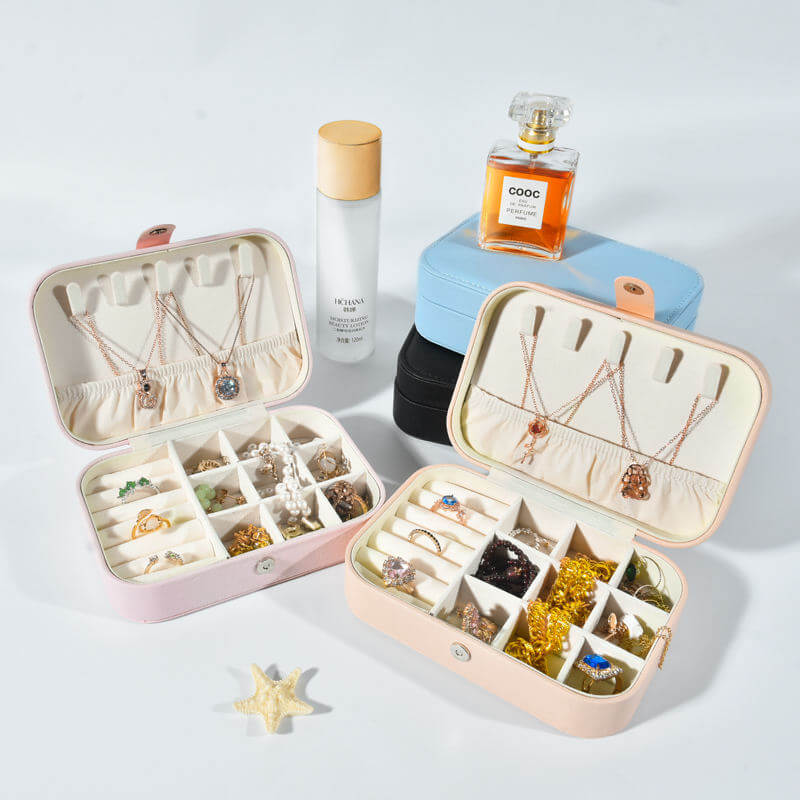
- Small jewelry (stud earrings, midi rings): Compact boxes (2–3 inches in width) with custom foam inserts or velvet slots that hold pieces securely. For example, Mejuri’s stud earring boxes are precisely sized to cradle each earring in a dedicated slot, preventing movement without compression.
- Medium jewelry (pendants, thin necklaces): Slightly larger boxes (4–5 inches in width) with a small compartment for the pendant and a loop to secure the chain, avoiding tangling.
- Large jewelry (statement necklaces, chunky bracelets): Spacious boxes (6–8 inches in width) with deep compartments or fold-out panels to accommodate bulk without forcing the piece into a tight space. Luxury brand Bulgari uses oversized yet structured boxes for its statement necklaces, with padded liners that hold the piece in place while preserving its shape.

2. Consumer Experience: From Unboxing to Long-Term Use
Packaging size directly influences how consumers interact with jewelry—from the first unboxing moment to years of storage. A well-sized package feels intentional, while a mismatched size creates frustration.
Undersized Packaging: Frustration and Perceived Carelessness
Undersized packaging often leads to a cumbersome unboxing experience:
- Difficulty accessing the product: Consumers may struggle to remove jewelry from a too-tight box, risking damage to the piece (e.g., bending a ring band while prying it from a narrow slot) or tearing the packaging. This frustration can overshadow the joy of receiving the jewelry.
- Poor long-term storage: Undersized packaging cannot accommodate jewelry for future use. A consumer who receives a necklace in a too-small box may be forced to transfer it to a generic container, losing the brand’s original packaging and weakening long-term brand connection.
Oversized Packaging: Waste and Disconnect
Oversized packaging, while sometimes seen as “luxurious,” often creates a disconnect between the product and its presentation:
- Anti-climactic unboxing: A small stud earring in a large, elaborate box feels mismatched—consumers may perceive the brand as wasteful or out of touch. The excess space dilutes the “wow” factor, as the jewelry gets lost in the packaging.
- Storage inconvenience: Oversized boxes are difficult for consumers to store at home (e.g., on a vanity or in a drawer). A consumer who receives a bracelet in a box twice its size may discard the packaging immediately, losing the opportunity for the brand to remain visible in their daily life.
Ideal Size: Seamless Experience and Emotional Resonance
A properly sized package enhances every stage of the consumer journey:
- Intuitive unboxing: The jewelry is easy to access (no prying or struggling) and is presented clearly—e.g., a ring in a box just large enough to showcase the piece without excess space. This creates a smooth, satisfying moment that reinforces the jewelry’s value.
- Functional long-term storage: The package doubles as a storage solution. For example, a compact earring box (sized to fit a jewelry drawer) encourages consumers to keep the packaging, ensuring the brand stays top-of-mind every time they use the jewelry.

3. Brand Perception: Size as a Signal of Value
In the jewelry industry, packaging size communicates value—whether intentionally or not. A mismatched size can undermine a brand’s desired image, while a well-calibrated size reinforces it.
4. Operational Costs: Size as a Driver of Efficiency
Packaging size directly impacts a brand’s bottom line, influencing production, shipping, and inventory costs. A poorly sized package can inflate expenses, while an optimized size reduces waste.
5. Environmental Impact: Size as a Factor in Sustainability
In an era of growing eco-consciousness, packaging size directly influences a brand’s environmental footprint. Mismatched sizes contribute to waste, while optimized sizes reduce resource use.
Undersized Packaging: Waste from Inadequate Protection
Undersized packaging may use less material upfront, but it often leads to indirect waste:
- Disposable replacements: Damaged jewelry from undersized packaging may require consumers to discard the piece (or the packaging) and purchase a replacement, increasing overall waste.
- Additional protective materials: To compensate for a too-small box, brands may add extra disposable materials (e.g., plastic sleeves) to protect the jewelry, negating any initial material savings.
Oversized Packaging: Direct Material Waste
Oversized packaging is a primary source of avoidable waste:
- Excess material: Large boxes use more cardboard, plastic, and ink—most of which ends up in landfills. The Ellen MacArthur Foundation estimates that 30% of packaging waste in the jewelry industry comes from oversized boxes.
- Transportation emissions: Larger packages require more fuel to ship, increasing carbon emissions. A study by the Sustainable Packaging Coalition found that oversized jewelry boxes increase transportation-related emissions by 25–40% compared to properly sized alternatives.
Ideal Size: Sustainable Sizing for a Lower Footprint
Optimized packaging size is a key pillar of sustainable jewelry packaging:
- Right-sized boxes: Using the smallest box that still protects the jewelry reduces material use and emissions. For example, Swedish brand AWJ uses “minimal right-sizing” for its earrings—boxes are just 2×2 inches, using 50% less cardboard than industry averages.
- Multi-functional sizes: Boxes sized to double as storage (e.g., a necklace box that fits in a jewelry drawer) reduce the need for additional packaging, extending the product’s lifecycle and minimizing waste.
Conclusion: Sizing as a Strategic Decision
The impact of packaging size on jewelry products is holistic—it touches every aspect of the product’s journey, from production to consumer use. Undersized packaging risks damage and cheapens perception, while oversized packaging drives up costs and wastes resources. The optimal size is not a “one-size-fits-all” solution but a strategic choice aligned with the jewelry’s type, brand identity, consumer needs, and sustainability goals.
For jewelry brands, the key is to approach sizing with precision:
- Map size to product type: Delicate pieces need compact, protective boxes; bulky pieces need structured, spacious ones.
- Align size with brand values: Luxury brands can use slightly larger, premium boxes; sustainable brands prioritize minimal, right-sized options.
- Test for efficiency: Evaluate shipping costs, return rates, and consumer feedback to refine sizing over time.
By treating packaging size as a critical strategic decision, brands can ensure their packaging enhances—not undermines—the value of their jewelry, creating a better experience for consumers and a more efficient, sustainable operation for themselves.
If you need help determining the best packaging size for a specific jewelry line, please feel free to contact us