

Jewelry packaging with interior dividers vs. jewelry packaging without dividers: Which is neater?

In the jewelry packaging industry, “neatness” is more than just visual order—it directly impacts product protection, consumer experience, and brand perception. For jewelry brands and packaging designers, choosing between boxes with interior dividers and those without boils down to balancing practicality (preventing tangles, scratches, or damage) with aesthetic goals (minimalism, showcase appeal, or gifting vibe). While both options have their place, their ability to maintain neatness varies drastically based on jewelry type, use case, and consumer behavior.
1. Defining “Neatness” in Jewelry Packaging: Beyond Visual Order
Before comparing the two designs, it’s critical to clarify what “neatness” means for jewelry packaging—it’s a combination of three core factors:
- Physical organization: Jewelry stays in place (no tangling, shifting, or stacking).
- Protection: No scratches, dents, or damage from friction between pieces.
- Visual clarity: The jewelry is easy to see, access, and present without clutter.
Both divider and non-divider packaging affect these factors differently, depending on how they’re used.

2. Jewelry Packaging with Interior Dividers: Precision Neatness for Multi-Piece or Delicate Jewelry
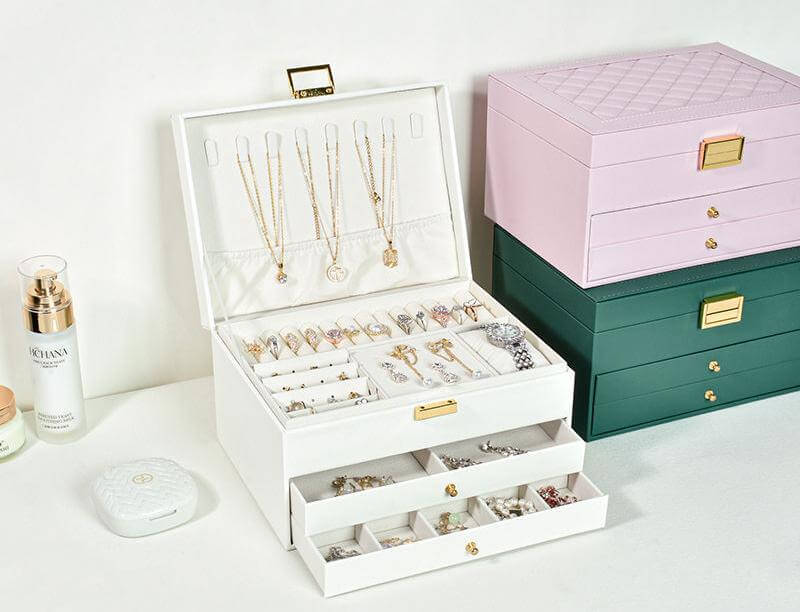
Interior dividers—whether fixed (e.g., foam inserts with pre-cut slots) or removable (e.g., fabric-lined partitions)—are designed to create separate compartments for individual jewelry pieces. Their greatest strength is contained organization, making them ideal for scenarios where neatness relies on preventing piece-to-piece contact.
How Dividers Enhance Neatness
- Eliminates tangling and scratching: For multi-piece sets (e.g., a necklace + earrings + ring gift set) or delicate items (e.g., thin chains, gemstone studs), dividers create physical barriers. A necklace chain won’t wrap around earrings, and a diamond ring won’t scratch a pearl pendant—this is the most critical form of neatness for high-value or fragile jewelry.
- Maintains intentional placement: Fixed dividers (e.g., a foam insert shaped for a specific ring or watch) hold jewelry in a pre-determined position, ensuring it looks polished even after shipping or handling. For example, luxury watch brands like Rolex use custom-divided boxes to keep the watch, extra links, and warranty card neatly separated—no shifting, no clutter.
- Simplifies access and storage: Removable dividers let consumers reconfigure the box for their needs (e.g., adding a partition for a new pair of earrings). This long-term neatness ensures the packaging remains functional beyond the initial unboxing, unlike non-divider boxes that can become messy as consumers add more jewelry.
Ideal Use Cases for Divided Packaging
Divided boxes excel at neatness when:
- Packaging multi-piece sets (gift sets, bridal jewelry bundles).
- Holding delicate or small items (stud earrings, thin necklaces, bracelets with charms).
- Designed for long-term storage (travel cases, vanity organizers).
- Targeting organized consumers (e.g., busy professionals, jewelry collectors) who prioritize order.
3. Jewelry Packaging Without Interior Dividers: Minimalist Neatness for Single-Piece or Statement Jewelry
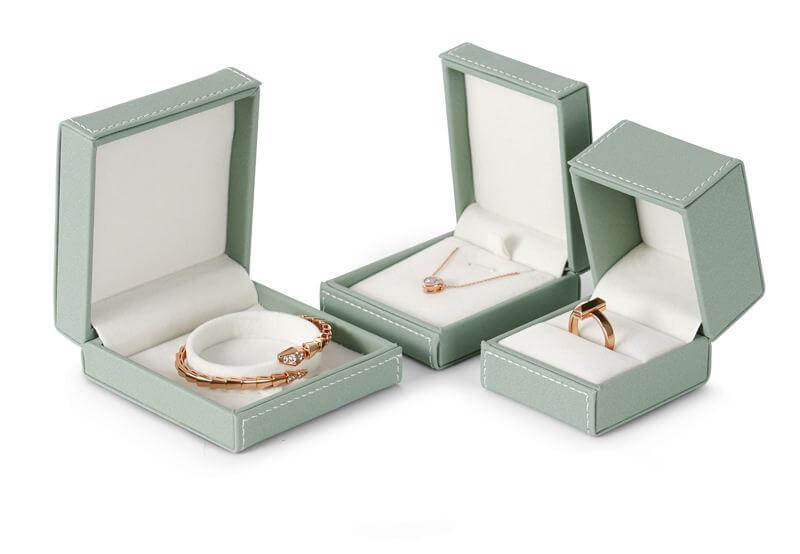
Non-divider packaging—often a single, open compartment lined with velvet, leather, or fabric—relies on simplicity to achieve neatness. Its strength is visual minimalism, but its ability to stay organized depends heavily on the number and type of jewelry pieces inside.
When Non-Divider Packaging Works for Neatness
- Single-piece presentation: For a single, standout item (e.g., a solitaire engagement ring, a bold statement necklace), a non-divider box keeps the focus on the jewelry without compartmental clutter. The piece sits centered in the lining, creating a clean, luxurious visual—this is “minimalist neatness” at its best. For example, Tiffany & Co.’s classic blue boxes (without dividers) showcase a single engagement ring beautifully, with no distractions from the piece itself.
- Soft, flexible lining: A plush velvet or leather lining in a non-divider box can gently cradle a single piece, preventing minor shifting. For a large pendant necklace or a chunky bracelet, the lining’s softness keeps the piece from sliding around excessively, maintaining a neat appearance.
- Gifting simplicity: For one-time gifting (e.g., a birthday necklace), a non-divider box is easy to pack and unwrap. The recipient sees the jewelry immediately, with no need to navigate partitions—this “uncomplicated neatness” works for casual or last-minute gifts.
The Neatness Risks of Non-Divider Packaging
Non-divider boxes struggle with neatness in two key scenarios:
- Multi-piece storage: Adding two or more items (e.g., a necklace + a pair of earrings) to a non-divider box almost guarantees tangling or stacking. A chain will wrap around earrings, and small studs may get lost in the lining—this quickly turns “minimalist” into “disorganized.”
- Long-term use: Over time, a non-divider box used for storage (not just gifting) becomes a catch-all for loose jewelry. Without compartments, pieces pile up, making it hard to find what you need and increasing the risk of scratches.
4. Side-by-Side Comparison: Neatness Factors for Divided vs. Non-Divided Packaging
To clearly weigh the two options, here’s how they perform across the three core neatness factors:
| Neatness Factor | Jewelry Packaging with Dividers | Jewelry Packaging Without Dividers |
|---|---|---|
| Physical Organization | Excellent—separates pieces, no tangling/shifting | Good only for 1 piece; poor for multiple pieces (tangles) |
| Protection | High—prevents friction/scratches between pieces | Low for multiple pieces; moderate for single, sturdy pieces |
| Visual Clarity | Structured—easy to see each piece; no clutter | Clean for 1 piece; cluttered for multiple pieces |
| Long-Term Use | Sustained neatness (reconfigurable dividers = adaptability) | Declines over time (becomes a catch-all for loose jewelry) |
| Multi-Piece Sets | Ideal—designed for organizing bundles | Not recommended—guarantees disorganization |
5. How to Choose: Align Neatness with Your Brand and Jewelry
The “neater” option depends entirely on your jewelry type, brand aesthetic, and consumer needs. Here’s a decision framework:
Choose Divided Packaging If:
- You sell multi-piece sets (gift sets, bridal bundles, or travel kits).
- Your jewelry is delicate or small (thin chains, gemstone studs, or watches).
- Your brand emphasizes practicality and organization (e.g., everyday jewelry brands, travel-focused labels).
- You want packaging to serve as long-term storage (not just one-time gifting).
Choose Non-Divider Packaging If:
- You focus on single-piece, high-impact jewelry (engagement rings, statement necklaces).
- Your brand aesthetic is minimalist or luxury-focused (e.g., high-end boutique brands, minimalist designers).
- The packaging is for one-time gifting (not long-term storage).
- You want to keep the unboxing experience simple and focused (no compartmental distractions).
Conclusion: Neatness Isn’t One-Size-Fits-All—It’s About Alignment
There’s no universal “neater” option between divided and non-divided jewelry packaging. Divided boxes deliver precision neatness for multi-piece or delicate jewelry, ensuring organization and protection long-term. Non-divided boxes offer minimalist neatness for single, standout pieces, keeping the focus on the jewelry itself.
The key is to match the packaging design to your jewelry’s needs: if you’re selling a bridal set with a necklace, earrings, and ring, divided packaging is the only way to keep it neat. If you’re showcasing a single, luxurious engagement ring, a non-divider box will highlight it cleanly. By prioritizing alignment over trend, you’ll ensure your packaging stays neat—and your jewelry looks its best.
If you need help perfecting this selection for a specific product (for example, a new jewelry set or limited edition gift box), you can contact our Professional Services team to compare divider and non-divider options to suit your exact use case.